 +1 888 285 9583
 +33 4 12 39 27 40


The client
Quebec municipal organization
- Sector: Municipal public sector
- Size: More than 1,000 employees
- Region: Quebec
A Quebec municipal organization had to choose between replacing its hardware and moving to Azure. io4 mapped nearly 200 servers, designed an Azure landing zone hosted in Canada and migrated about fifteen servers in a pilot with no unplanned downtime. Anonymized client: figures are rounded to protect confidentiality.
Results at a glance
Key figures.
≈ 200
Servers mapped
With their dependencies and actual usage
≈ 25%
Lower infrastructure costs
Over 5 years, compared with replacing the hardware
1/3
Less capacity to pay for
Thanks to right-sizing based on measured usage
0
Unplanned downtime
During the pilot of about fifteen servers
The context
This municipal organization delivers essential services to citizens around the clock. Behind those services, nearly 200 Windows and Linux servers run several dozen applications, including specialized line-of-business systems.
The main hardware was nearing end of life, and renewing virtualization licenses and support contracts meant a major short-term expense. The organization had to decide: reinvest in hardware for five more years, or move its workloads to Azure.
Elected officials wanted a solid business case before committing funds. The IT team knew the environment documentation was several years old and that some application dependencies were known to only a few people. The constraints were clear:
- Continuity of citizen services, with critical systems running day and night.
- Compliance with Quebec's Law 25 and data hosted in Canada.
- An IT team busy with day-to-day operations, with little time for a major project.
- A municipal budget calendar that required a business case ready for the next fiscal year.
The io4 approach
The io4 team ran the engagement in three phases over 18 weeks: environment discovery, target architecture, then a migration pilot.
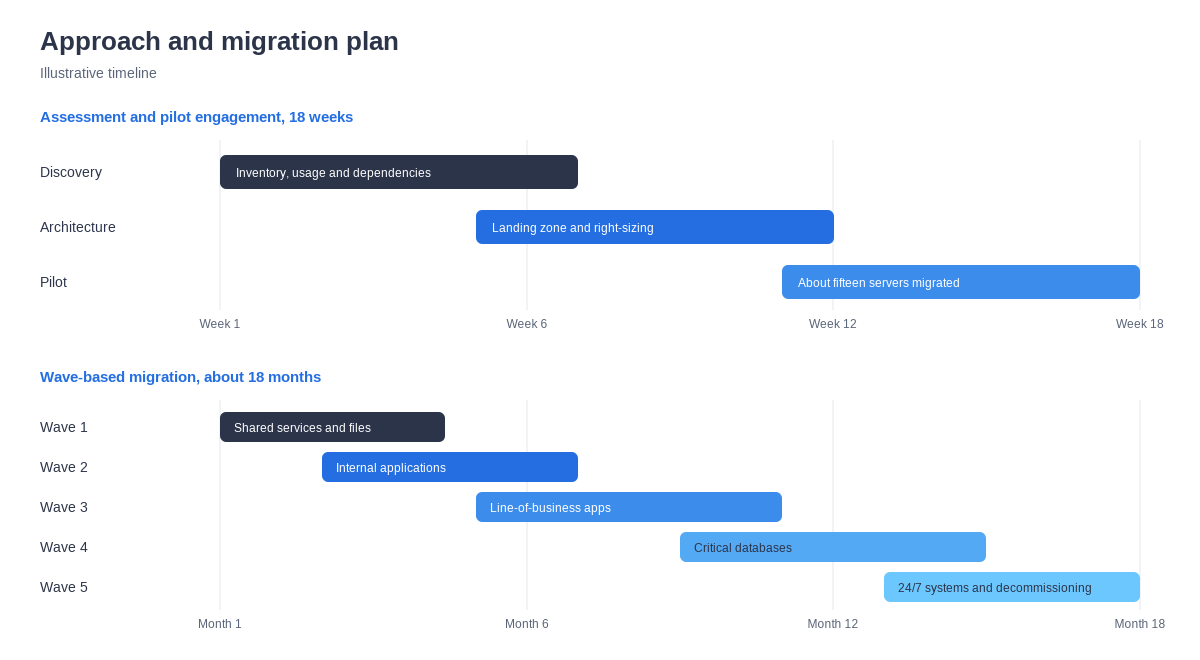
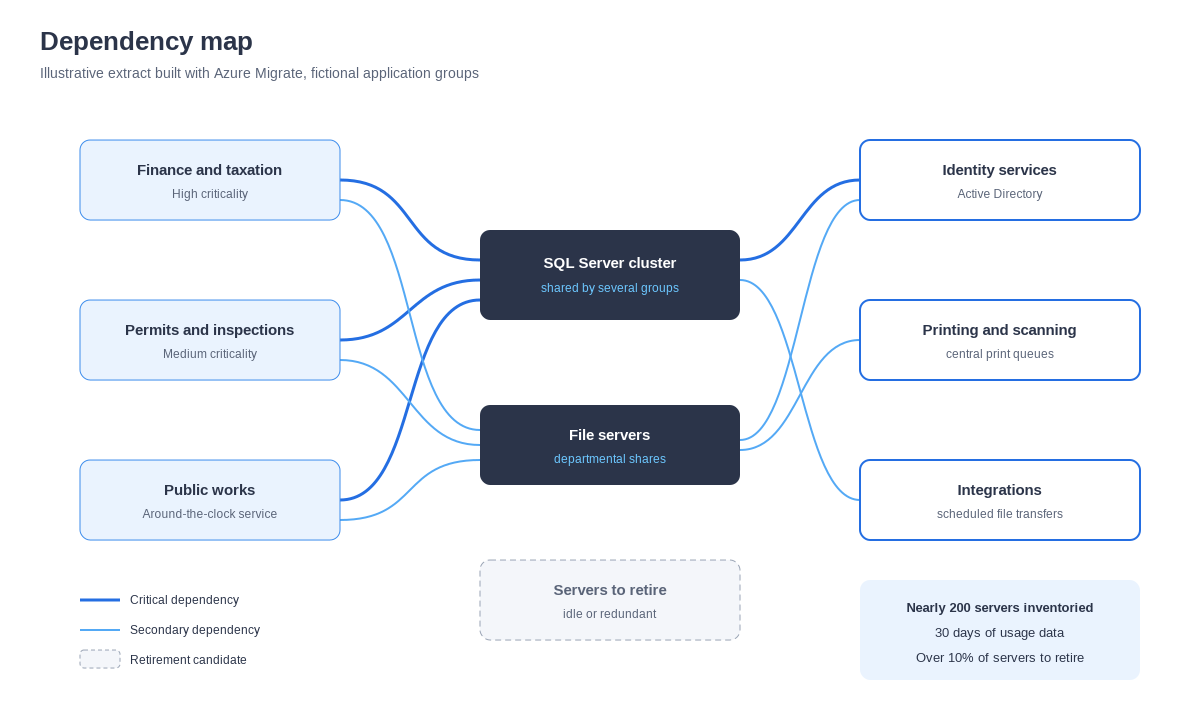
Discovery. Azure Migrate automatically inventoried the servers and measured their actual usage over 30 days. Dependency analysis traced the flows between applications, databases and services, complemented by workshops with each department's leads. The result: a complete inventory, more than twenty servers flagged for retirement or consolidation, and one sheet per application with its criticality, dependencies and recommended migration strategy.
Target architecture. The io4 team designed an Azure landing zone following Microsoft's Cloud Adoption Framework, in the Canada Central and Canada East regions: hub-and-spoke network, private ExpressRoute connection to the buildings, identities in Microsoft Entra ID and governance enforced by Azure Policy. Microsoft Defender for Cloud, Azure Monitor and Azure Backup cover security, monitoring and backup. Each server was right-sized to its measured consumption, with Azure Hybrid Benefit applied to existing Windows Server and SQL Server licenses.
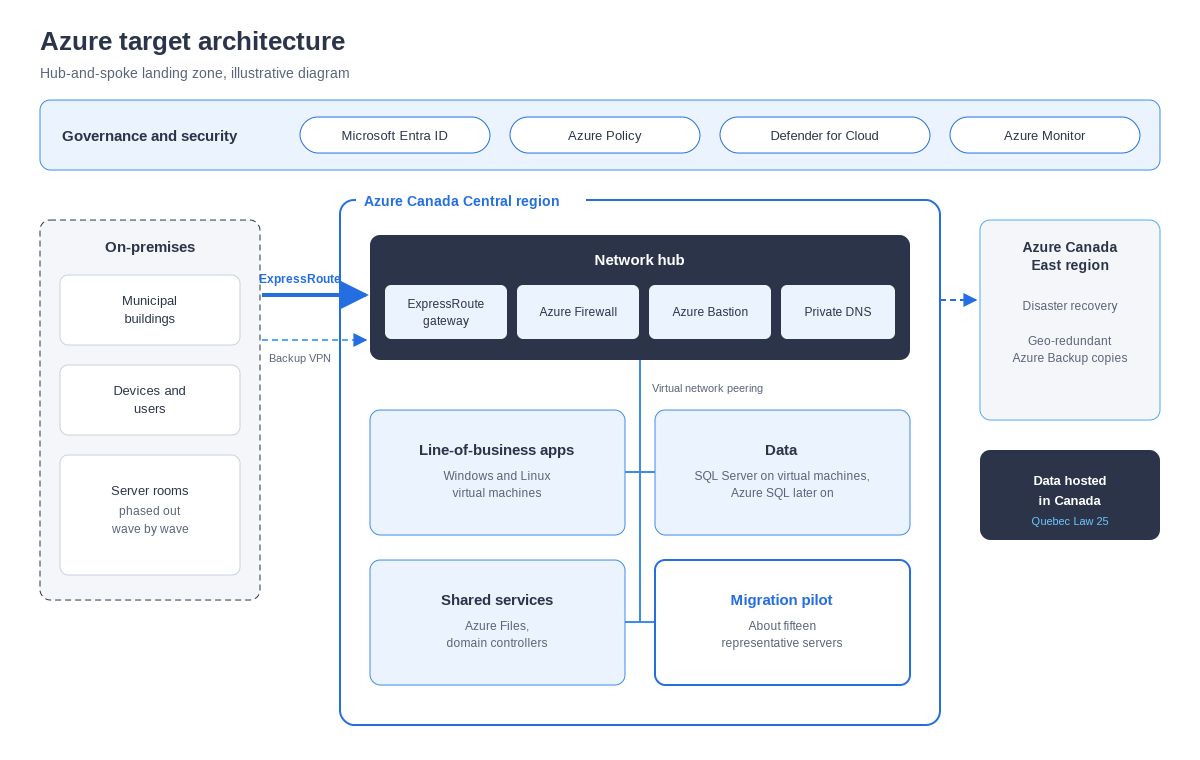
Pilot. About fifteen representative servers were migrated with Azure Migrate: internal applications, a file server, SQL Server databases and a line-of-business application. Cutovers took place at night and on weekends, with a tested rollback plan for each server. The internal IT team took part in every step to build its autonomy.
A lift-and-shift approach was chosen for most servers to meet the hardware deadline. The newest applications were earmarked for later modernization to PaaS services such as Azure SQL Database.
The results
Measured at the end of the pilot, then two months later:
- All servers and applications mapped with their dependencies, starting from partial documentation.
- More than 10% of servers retired or consolidated before migration.
- Projected Azure capacity about one third smaller than current capacity, thanks to right-sizing based on actual usage.
- Five-year infrastructure costs about 25% lower in the business case, compared with replacing the hardware.
- About fifteen servers migrated during the pilot, with zero unplanned downtime.
- Server restore time reduced from nearly a day to a few hours with Azure Backup.
- A wave-based migration plan over about 18 months, presented to management.
What other organizations can take away
- Measure actual usage before sizing. Thirty days of Azure Migrate data show the capacity really in use, and accurate sizing makes the biggest difference on the bill.
- Clean up before you migrate. Every server retired during discovery is a recurring saving and one less migration to plan.
- Start with a representative pilot. A small, varied group of servers validates the architecture, procedures and cutover windows, and prepares the internal team for the next waves.
Microsoft technologies used
A similar topic?
Let's talk about your context.
A free assessment with the io4 team. No commitment, no pressure. You leave with a reasoned point of view.