 +1 888 285 9583
 +33 4 12 39 27 40


SEAO, Conseil du trésor general terms, Law 25 compliance, Canada Central hosting. The bare minimum you need to understand so you aren't disqualified the moment you submit.
Microsoft public tenders in Québec in 2026
SEAO (Système électronique d'appel d'offres) is the single portal Québec public bodies use to publish their tenders. In 2026 it carries a large volume of notices touching on IT advisory services, cloud infrastructure, cybersecurity, Microsoft 365 migration, and Copilot deployment.
For a private firm, responding to a SEAO tender is rarely intuitive. The rules aren't the ones you know from the private sector: administrative compliance sometimes carries as much weight as technical quality, public bodies require a documented decision trail (the LCOP and its regulations), and the deadlines are strict.
This article sums up the essentials so you aren't disqualified the moment you submit - which happens more often than you'd think.
The legal framework for public contracts: LCOP and LCOM
Ministries, public bodies, the health and education networks and Crown corporations apply the Act respecting contracting by public bodies (LCOP) and its regulations; since April 1, 2026, municipalities apply the Act respecting contracting by municipal bodies (LCOM), which carries the same integrity requirements. This common framework notably provides for:
- A bid bond when the tender documents require one (more common in construction than in IT services).
- An authorization to contract from the Autorité des marchés publics (AMP) for service contracts and subcontracts of $1M or more ($5M for construction).
- A valid Revenu Québec attestation as of the submission date (required for contracts of $25,000 or more).
- A commitment to the Contract Compliance Program for employment equity, for businesses with more than 100 employees in Québec bidding on a contract of $100,000 or more.
- Compliance with the Charter of the French language (bid and deliverables in French, under the conditions set by the public body).
- Without these administrative documents up to date, your bid is thrown out before the technical committee even opens it.
Privacy requirements in public tenders
Since Law 25 came into force, public RFPs systematically include clauses on the protection of personal information. What you absolutely have to demonstrate in your response:
- Your own organization's compliance with Law 25 (a designated privacy officer, a public privacy policy, a PIA for this engagement).
- A contractual commitment on the confidentiality, retention, and destruction of any personal information entrusted to you.
- A map of the subcontractors and third parties involved, along with their own compliance commitments.
- Data residency: Canada Central / Canada East hosting, a frequent criterion in the Québec public-sector RFPs we analyze. State explicitly which Azure regions you'll use.
- Incident notification mechanisms (timeline, contact, procedures).
- A service-exit plan: return, deletion, and a destruction attestation for the data at the end of the contract.
Canada Central hosting: a critical issue
This is a frequent criterion in the Québec public-sector RFPs we analyze. The implicit rule: the body's personal information and operational data must stay in Canada, ideally in Québec.
Microsoft has two Canadian regions: Canada Central (Toronto) and Canada East (Québec). Microsoft 365 data for a Canadian tenant is stored at rest in the Canada geography, spread across these two regions. For Azure, you can pick the exact region.
Special case: some bodies (notably in healthcare) explicitly require Canada East. Check the specifications. Microsoft 365 doesn't offer a Canada East tenant option, which can create a compliance issue - a trade-off that's often acceptable with some documented back-and-forth, but one to anticipate.
Hosting outside Québec, including in Toronto, comes with a privacy impact assessment (section 70.1 of the Access Act); favour Canada East when the public body asks for it.
Document it precisely in your response: "The Microsoft 365 tenant data will be hosted in the Canada geography (Toronto and Québec City data centres). The Azure workloads deployed under this engagement will run in the Canada Central region, with geo-redundant backups to Canada East."
Typical scoring weights
Public-body selection committees generally use a two-stage grid: technical quality first, price second. The typical weighting in IT:
- Understanding of the need (10-15%): did you read the specifications, do you grasp what's at stake for the body?
- Expertise and experience (20-30%): references on similar engagements (size, sector, technology), résumés of the proposed resources, certifications.
- Methodological approach (15-25%): phases, deliverables, project management, change management, governance.
- Risk and quality management plan (10-15%): risks identified, mitigation measures, quality control.
- Price (20-30%): typically the lowest bid gets the top score, with a penalty formula for the gaps.
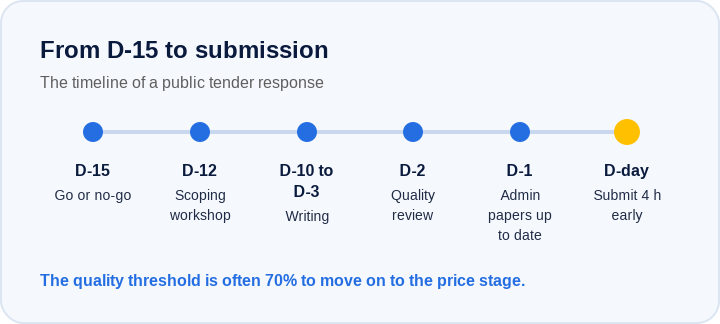
- Very often, the minimum quality threshold is 70% to move on to the price stage. A bid below 70% is eliminated, no matter the price.
Pitfalls that disqualify you on submission
Across the RFPs we've won and lost since 2018, here are the most common administrative disqualifications we've seen among competitors:
- An expired Revenu Québec attestation (it is valid until the end of the third month following the month it was issued).
- A bid bond in the wrong format (an uncertified cheque, an insufficient amount, a cheque made out to the wrong payee).
- A response not signed by an authorized person (a missing board resolution).
- A non-compliant format: public bodies often impose a specific response format (a Word template, numbered sections, a page limit). Any overage = elimination.
- A late submission, even by two minutes. The SEAO servers are strict about the official time.
- Undeclared subcontractors or an undisclosed conflict of interest.
Our approach to responding
At io4, we follow a proven method for every qualified RFP:
Day -15 - Go/no-go decision: a thorough review of the specifications, the response-effort-to-win-probability ratio, and alignment with our expertise (Microsoft 365 / Azure / security).
Day -12 - Internal scoping workshop: a senior architect plus a project lead decode the real need behind the requirements.
Day -10 to -3 - Drafting the response: methodological approach, proposed team, references, detailed plan.
Day -2 - Quality review by a senior who wasn't involved in the drafting: format compliance, consistency, and the relevance of the references.
Day -1 - Administrative validation: every attestation up to date, the bid bond prepared, the signatures obtained.
Submission day - SEAO upload no later than four hours before the deadline (to avoid any connection surprises).
This discipline lets us win a significant share of the RFPs we choose to respond to - precisely because we only respond to RFPs where we have genuinely differentiating expertise.
Sources
- Québec government electronic tendering system (SEAO)
- Integrity in public contracts: authorization to contract and Revenu Québec attestation (Québec.ca)
- Regulation respecting contracting by public bodies in the field of information technologies (LégisQuébec)
- Microsoft 365 datacenter locations (Microsoft Learn)
Want to talk it through?
Let's spend 30 minutes on your situation.
A free assessment with the io4 team. No commitment, no pressure.
Book my assessment