 +1 888 285 9583
 +33 4 12 39 27 40


Merger, spin-off, acquisition, separation: a Microsoft 365 tenant-to-tenant migration is a high-risk exercise. A proven method, the things to watch for, and field notes from a 4,000-user project.
When to consolidate two Microsoft 365 tenants
A Microsoft 365 tenant-to-tenant migration is never a project you take on for fun: it's almost always the consequence of a corporate event. A merger, an acquisition, a spin-off, an exit from a group, a restructuring, a major rebrand, or consolidation after several years of growth through acquisition.
Unlike an on-premises-to-Microsoft 365 migration - where Microsoft's tooling is mature and well documented - migrating between two Microsoft 365 tenants remains a high-risk exercise. Microsoft now offers a native orchestrator (Cross-Tenant User Data Migration licence) that migrates mailboxes, OneDrive, Teams chats and meetings; teams, channels and SharePoint sites call for complementary tools, and some items (shared OneNote notebooks, certain SharePoint metadata) are planned separately.
The 6 phases of a successful tenant-to-tenant migration
Whatever the size of the project - from 50 to 50,000 users - we always break the migration into six phases. Skip a phase and you're guaranteeing a major incident.
- Phase 1 - Scoping and inventory (2 to 4 weeks): audit both tenants and map the objects to be migrated (mailboxes, SharePoint sites, Teams teams, OneDrives, security groups, service accounts, registered applications).
- Phase 2 - Target architecture and tool selection (1 to 2 weeks): decide on identity (coexistence, AD merge, target Microsoft Entra Connect), choose the main migration tool (BitTitan MigrationWiz, Quest On Demand Migration, ShareGate, AvePoint Fly), and define the DNS cutover schedule.
- Phase 3 - Coexistence and pilot (2 to 4 weeks): set up cross-tenant free/busy, shared SMTP routing, and an intermediate routing domain, then run a pilot migration on 20 to 50 representative users.
- Phase 4 - Main wave (2 to 8 weeks depending on size): migrate in waves of 100 to 1,000 users depending on the environment's maturity, usually over weekends. Cut over the MX records once the final wave is complete.
- Phase 5 - Cleanup and hand-over (2 to 3 weeks): remove source objects, remove cross-tenant shares, lock down the new tenant, and hand over documentation.
- Phase 6 - Post-migration support (4 to 6 weeks): reinforced help desk, support for edge cases, and resolution of items that didn't migrate (often 1 to 3% of the volume).
The tools we use
Our go-to tool is AvePoint Fly: it covers the full scope of a tenant-to-tenant migration — Exchange mailboxes, OneDrive, SharePoint sites (preserving metadata, versions, and inherited permissions), and Teams end to end, including chat history (recent months migrated directly, the full history archived and searchable in OneDrive) and tabs. Being able to migrate everything from a single platform simplifies the project and reduces the risks that come with stitching multiple tools together.
Depending on the client's preferences and ecosystem, we also work with other proven solutions, on their own or as a complement:
BitTitan MigrationWiz: robust and scriptable for Exchange mailboxes and OneDrive, with excellent error handling.
Quest On Demand Migration and ShareGate: especially strong on SharePoint, preserving metadata, versions, and inherited permissions.
For identity, Microsoft Entra Connect (or Entra Cloud Sync) on the target side is planned as early as phase 2. If you're merging on-premises AD, budget an extra 4 to 8 weeks for the forest restructure (ADMT, Quest Migration Manager).
The critical things to watch for
Across 30 tenant-to-tenant projects over the past 4 years, here are the recurring pitfalls:
- DNS and email coexistence: a bad MX record for 4 hours means thousands of emails delayed or bounced back to the sender. Always plan for a temporary routing domain (e.g., contoso-mig.onmicrosoft.com).
- Service accounts and registered applications (inscriptions d'applications Entra ID): often forgotten. Every third-party integration (CRM, ERP, e-signature) has to be re-authorized in the target tenant.
- Teams Phone (Direct Routing, Calling Plans): requires a full re-subscription, and sometimes re-acquiring the numbers through the carrier. Lead time of 2 to 6 weeks depending on the carrier.
- Purview sensitivity labels: they don't migrate. They have to be recreated in the target tenant before document migration begins, or the files end up with no label.
- Viva Engage and Stream videos (now in SharePoint and OneDrive): separate exercises, to plan on their own.
- Licensing: double-paying is unavoidable for 4 to 12 weeks (both tenants active at the same time). The budget has to account for it.
Field notes: 4,000 users in 12 weeks
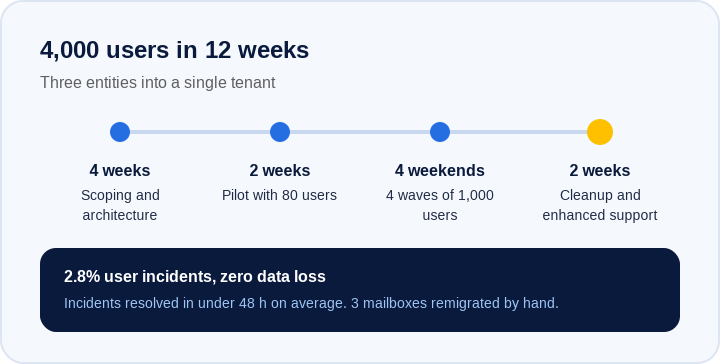
A recent engagement is a good illustration of how this plays out. A Québec group consolidating three entities (4,000 users in total) into a single tenant. Three sources, one target. Volume: 18 TB of OneDrive, 240 SharePoint sites, 380 Teams teams, 4,200 mailboxes.
Timeline: 4 weeks of scoping and architecture, 2 weeks of piloting on 80 users, 4 cutover waves of 1,000 users each spread across 4 consecutive weekends, and 2 weeks of cleanup and reinforced support. Total: 12 weeks.
Post-migration user incident rate: 2.8% (resolved in 48 hours on average). Zero document data loss. Three mailboxes had to be re-migrated manually due to source Exchange corruption.
Preparing a merger, acquisition or consolidation? Our Microsoft 365 and Azure migration services cover the assessment, pilot, cutover waves and hypercare.
Sources
Want to talk it through?
Let's spend 30 minutes on your situation.
A free assessment with the io4 team. No commitment, no pressure.
Book my assessment