 +1 888 285 9583
 +33 4 12 39 27 40


Microsoft has been disabling Exchange Web Services since October 2026, ahead of the final shutdown in April 2027. The tools to inventory in your tenant and how to move to Graph.
The Exchange Web Services retirement most SMBs never saw coming
Since October 1, 2026, EWS has been disabled by default, tenant by tenant: an application that still relies on it can stop working overnight. The final shutdown is set for April 1, 2027. For a Québec SMB, the problem isn't the API itself — few people know what EWS even is — it's everything quietly built on top of it: the mailbox backup tool, the company email-signature solution, legal archiving, certain CRMs, in-house line-of-business connectors. The day EWS goes dark, those tools stop working, often with no clear error message.
This is the kind of deadline that is easy to miss, because end users see nothing until a tool stops working. Microsoft confirmed the EWS retirement timeline back in 2023; the Midnight Blizzard incident of January 2024, which exploited EWS, added urgency and extended the scope to Microsoft's own applications. So this is as much a Modern Work file as it is a cybersecurity one.
What EWS is — and why Microsoft is pulling the plug
EWS is a programming interface launched in 2007 that lets an application read from and write to Exchange mailboxes: email, calendars, contacts, tasks. For fifteen years, most third-party tools that touch messaging went through it. Microsoft announced back in 2018 that EWS would receive no further feature updates — a clear signal the technology was end-of-life.
The reason for the retirement is, above all, security. EWS is an older API whose permissions often grant access to entire mailboxes, which are harder to restrict than with Graph. The Midnight Blizzard incident showed that a nation-state attacker could abuse EWS to reach mailboxes, which widened the scope of the retirement: not only third-party applications, and some Microsoft applications also use EWS and are gradually moving to Graph. Check the dependencies of your own applications. The designated successor is Microsoft Graph, the unified, modern API of the Microsoft 365 ecosystem, built on Entra ID authentication and least-privilege access.
The timeline that matters
Three milestones frame the decision, and they call for action now.
- Since October 1, 2026: EWS is disabled by default, tenant by tenant. Admins can temporarily re-enable it or allow specific applications (EWSAllowedAppIDs setting).
- April 1, 2027: final shutdown, with no re-enablement possible.
- Starting today: treat the default disablement as a full-scale test — every application that stops working reveals a dependency to migrate.
What will break in your environment
The real work isn't the date — it's the inventory. In the estates we audit at io4, EWS almost always hides in four places:
- Mailbox backup and archiving: several Microsoft 365 backup and legal-archiving solutions read mailboxes via EWS. Archiving that stops silently is a direct Law 25 compliance risk.
- Company signatures and marketing tools: signature managers and email platforms rely on EWS to inject into Exchange.
- Line-of-business apps and in-house connectors: internal PowerShell scripts, CRM/ERP integrations, document management, custom-built booking tools.
- Old clients and devices: "scan-to-email" multifunction printers, legacy calendar or meeting-room booking apps.
Inventory first: the Microsoft tools to see clearly
Microsoft provides a valuable starting point for this inventory: the EWS Usage Reports in the Microsoft 365 admin center, which reveal which applications still call EWS in your tenant, plus a code-analysis tool (EWS Analyzer) for internal development. Visibility is where to start — the same reflex as for security or cloud costs: you only fix well what you've first measured.
Moving to Microsoft Graph without breaking things
For most common scenarios, Microsoft Graph already offers the EWS equivalent, with documented mappings between EWS operations and Graph APIs. The benefit goes beyond simply meeting the deadline: Graph brings modern Entra ID authentication, granular permissions (an application accesses only what it strictly needs), and a reduced attack surface. In other words, moving off EWS also hardens your security posture.
A few grey areas remain: some advanced functions (mailbox import/export, public folders, archives, certain administration APIs) aren't yet at full parity on Graph and are shipping progressively. For an SMB, these cases stay marginal, but they reinforce the rule: audit early to spot a possible uncovered scenario and adapt the plan, rather than discovering it at the final shutdown in April 2027.
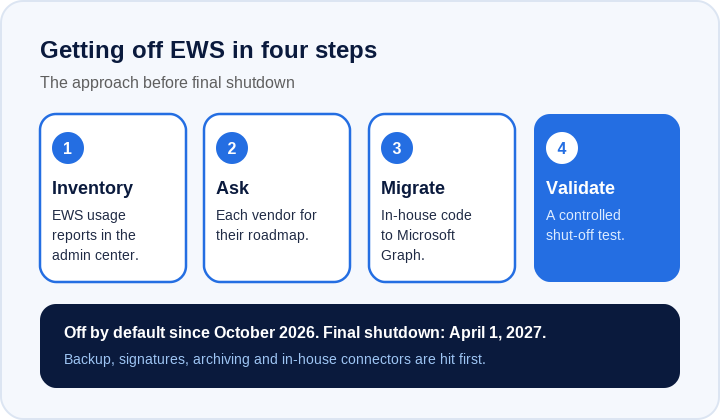
The approach we recommend has four steps: inventory EWS dependencies via the Microsoft reports, press your third-party vendors for their migration roadmap (a serious vendor already has one), migrate or replace your internal development to Graph, and validate with a controlled disablement test before the forced cut-off.
Bottom line: complete the inventory before April 2027
EWS retirement isn't a distant developer topic: it's a concrete operational risk for any organization on Exchange Online, with a hard deadline. Companies that complete their inventory now keep a few months to coordinate their vendors and migrate before April 1, 2027.
If you want to know what, in your tenant, still depends on Exchange Web Services, talk to an io4 expert. We run the dependency inventory, the coordination with your vendors, and the migration to Microsoft Graph with the same method we use across the rest of your Microsoft environment: visibility first, decisions second.
Sources
- Deprecation of Exchange Web Services in Exchange Online (Microsoft Learn)
- Exchange Online EWS, Your Time is Almost Up: disablement timeline (Exchange Team Blog)
- Exchange Web Services (EWS) usage report in the Microsoft 365 admin center (Microsoft Learn)
- Migrate Exchange Web Services (EWS) apps to Microsoft Graph (Microsoft Learn)
- Exchange Online EWS application stopped working? Do this (Exchange Team Blog)
Want to talk it through?
Let's spend 30 minutes on your situation.
A free assessment with the io4 team. No commitment, no pressure.
Book my assessment